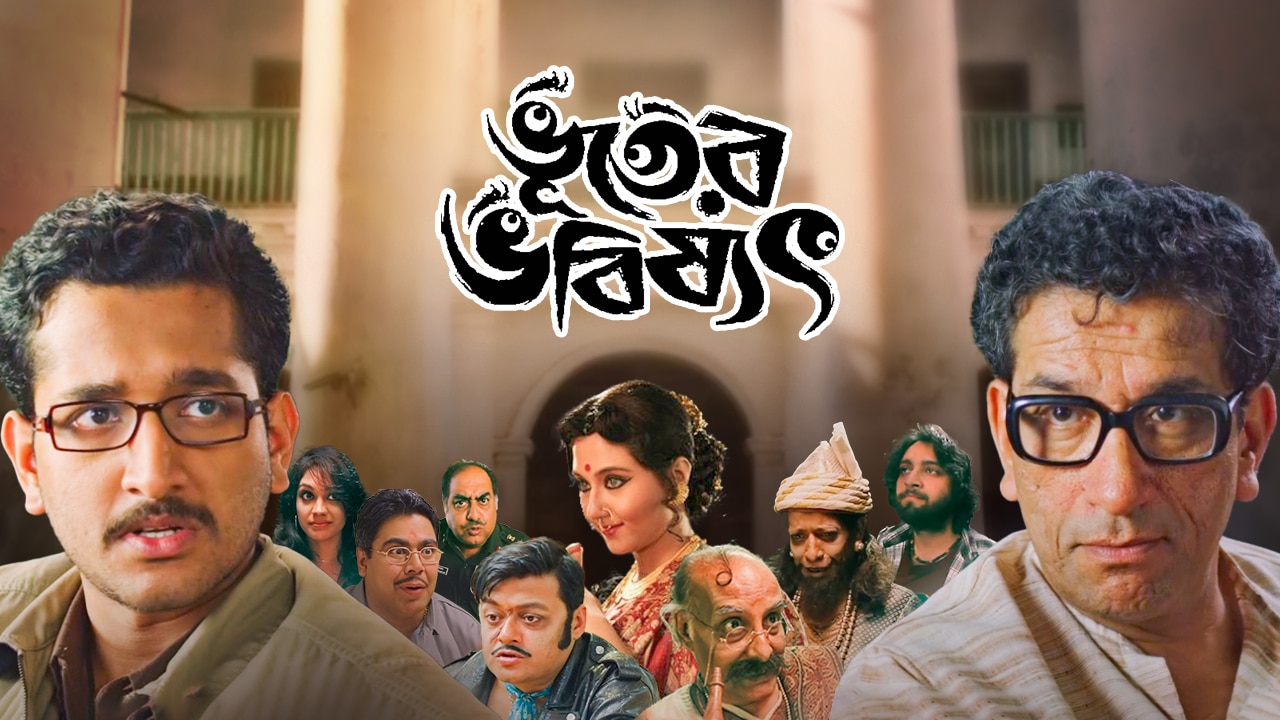
As an enthusiast of cinema, there’s always an enticing opportunity to engage in critical analysis of a film. In this blog post, the focus is on one of my personal favorites, “Bhooter Bhabishyat” (2012), directed by Anik Dutta. The article delves into various aspects of the film, including its basic plot, storytelling techniques, thematic elements, setting, and the role of music in enhancing the overall cinematic experience.
The 2012 Bengali Tollywood film shot to fame thanks to its unconventional plot, horror-comedy concept, and superb directing. Sabyasachi Chakrabarty, Parambrata Chatterjee, Paran Bandopadhyay, Swastika Mukherjee, Sumit Samaddar, Biswajit Chakraborty, Mir Afsar Ali, Saswata Chatterjee, Sreelekha Mitra, and Samadarshi Dutta are among the glamorous cast members.
The movie opens with advertising director Ayan Sengupta touring a mansion-like residence in search of a fresh place to film an upcoming commercial. When an actress passed out while filming in the same estate, word spread that the mansion is haunted. She claimed to have seen an unidentified woman’s reflection in the mirror when she regained consciousness.
Even though Ayan wants to make his film, he lacks the funds to do so. Ayan begins exploring the estate when he is left on his own to wait for the camera director. He drifts off to sleep in an antique-filled chamber before being woken up by a man. After learning about Ayan’s job and his desire to make an original film but missing the necessary cash and an interesting plot and storyline, the man begins talking to Ayan and tells him a scenario that could work as the premise for his feature film.

The story opens with a fascinating and unusual topic: spirits of the dead that continue to haunt the planet. The speaker argues that the city’s culture and legacy are being destroyed by developers who are tearing down historic mansions and homes to make way for multiplexes, creating a crisis of housing for ghosts. It’s interesting to see that worries about food, amusement, and security extends to the souls of the dead. Thus, the audience is instructed to consider this specific mansion—where Ayan is, for instance—as the focal point of the narrative.
The Chowdhury Mansion, the story’s focal point, is haunted by its previous owner, as he chose to make it his permanent home after his death at the hands of dacoits. A call for ghosts to occupy the abandoned Chaudhary mansion was made by the Zamindar and the other spirit of a British officer serving in pre-independence India who was killed by a bomb thrown by a freedom fighter. However, due to the enormous number of applicants for a room at the house, the pair decided to choose applicants via an interview board!The candidates chosen are the Royal Cook of Siraj-ud-Daulah, who lost his life in the Battle of Plassey; an actress and singer from the 1940s who killed herself after her producer boyfriend left her and married someone else; an Indian army officer who died in the Kargil War; a singer from a Bangla rock band who overdosed; a Hindu refugee from Bangladesh who perished during the partition by a train accident; a Bihari Rikshawala killed by a reckless driver; and, lastly, a modern-spoiled rich girl who killed herself by jumping off an apartment after her Industrialist father forbade her to marry a person of a different religion. There is also the mention of a distant relative of the Chaudhary Zamindar whose spirit took shelter in the Mansion after he was killed in the Naxalite era;his death and face are not revealed to the audience.
The circumstances, living conditions, periods of residency, and even professions of the selected candidates vary significantly. But the fact that they all passed very suddenly and in an unusual way unites them all. The initial phase of the story unfolds as the ghosts acquaint themselves with life in the Chowdhury mansion, leading to initial conflicts stemming from their differences. Amidst the chaos and clashes among the residents, the mansion transforms into an amusing pandemonium. Despite the tumultuous beginning, the spirits gradually find a chaotic harmony in settling down within the house. Yet, tranquility is short-lived when a plot dealer endeavors to demolish the mansion to erect a shopping mall on its grounds. Now, the ghosts must unite to devise a plan to preserve the mansion, their sole haven and refuge in the afterlife.

The character of the director is the voice who narrates the scenario and setting to the audience. In the very first scene, the location of the house is revealed by the character of the actress who fainted from ghost sighting: an old house in Northern Calcutta which is a Heritage site. In reality, it is the 250-year-old Shrerampore Rajbari, known for its exquisite architecture, mystical ambiance, and rustic surroundings. The house is depicted as a character in its own right, evolving alongside its residents over the years.
The first scene starts with an actress in heavy costume jewelry which is very synonymous with Bengal society and stereotypical look. The theme of some things suspicious and unseen is settled in the first scene where the actress passes out after seeing something unseen in the mirror during a shot.
The house is a setting of a culmination of different periods. When Ayan is taking a tour of the house, he stumbles upon various antique artifacts from different time periods in the house, though the conditions are very neglected. It is indeed a perfect setting for a group of ghosts from different time periods. Ayan Describes the setting as a “Time wrap”, which is indeed true. This creates the perfect Mise en scene.

Throughout the film, the audience is primed with expectations, such as the existence of hidden treasure in the house, rumored to be British-era coins. These expectations are confirmed when the ghosts offer the treasures to Ayan, urging him to shed light on their plight through his film.
Interestingly, the storyline Ayan intended to adapt into a film becomes condensed into the backstory of a single character, the Bangla band musician ghost, which Boplob rightly concludes as “ a new wine in an old bottle”. This subtle critique hints at the industry’s lack of creativity, positioning the film as a refreshing original.
Each new character introduction in the film employs a distinct editing style and filter to evoke a specific period. Director Ayan’s character narrates his intentions, offering viewers an insider’s glimpse into his creative process. The scenes featuring the oldest spirit, Darpanarayan Chowdhury, are tinted with a red filter, while a black frame closing shot creates a cinematic effect within the viewer’s screen. Ramsay Saheb, the British officer, is portrayed with a vintage gray filter overlaid with a hint of yellow, contrasting with Darpanarayan Chowdhury’s era. Kadalibala, the jilted actress, is depicted in black and white, reflecting the rise of Bioscope cinema, with her comical accent edited to resemble an old recorder playing. Despite her eerie entrance into Chaudhary Palace against a grayscale night sky, the scene balances humor and creepiness with the help of music and dialogue. Narrator Biplob’s era is shot in black and white with shaky, jerky movements, capturing the turmoil of the Naxalite period.
When Biplob Das Gupta’s story and demise are recounted, his death scene is notably omitted, piquing viewers’ curiosity and hinting at a deeper significance. This omission serves as a subtle indicator that his death holds greater meaning yet to be unveiled. The symbolic significance of Biplob’s name, meaning “revolution” in Bengali, adds layers to the intrigue, suggesting that his presence may not be easily discerned, a notion underscored by the wordplay. As the director inquires about Biplob’s presence within the narrative, viewers receive further confirmation that the narrator is indeed the departed Biplob’s spirit. Ultimately, the narrator unveils his own scene in a dramatic revelation, confirming his identity as the storyteller guiding Ayan through the tale.
The comedic essence is accentuated by the interview board set-up to assess the worthy ghostly candidates at Chaudhary Palace. Each ghost character remains true to their former selves, while the background music captures the chaotic ambiance of the interview hall, featuring a blend of languages, military tunes, and whimsical instruments. Even the ghosts themselves are bewildered by each other’s antics and personalities. Interestingly it is shown that the spirits carry their early bodily problems in the afterlife as well, be it having a weak stomach to handle spicy meals or suffering from arthritis, which makes it difficult to haunt tall trees.
For the Bhoot Chaturdashi or the Holy Night of the Ghost, the cultural festival hits a nostalgic nerve among the audience with its word alterations of famous songs to present a comical effect. In the fashion show organized by the ghosts, every character is dressed as the opposite of their nature, which shows that in the afterlife you can be anyone. And though there may be differences among the spirits in their haunting habitat, there is no such difference in the afterlife.

The most amusing aspect of the film is the dialogues and its amazing take on language. Nearly every character delivers dialogue in rhythmic cadences, with humor often subtle and situational. While literary and political references abound, language plays a pivotal role in the film’s comedic appeal. Witty exchanges, puns, wordplay, innuendos, oxymorons, poetic dialogue, and alliterations abound, harnessing the power of language to evoke laughter. The ghost characters remain true to their identities; for instance, the Naxal leader’s heavy dialogue reflects his communist mindset. A highlight of the film is its title, which cleverly plays on the word “Bhoot” in Bengali, meaning both “ghost” and “past.” Thus, the title can be translated as “future of the past,” adding an additional layer of depth to its meaning.
Though the film spectacularly accommodates so many ears in a single timeline, the costume plays a crucial role. The attire of the human characters in the film exudes a nostalgic yet realistic charm. Ayan’s assistant director, Rinka, embodies the quintessential Bengali thinker and creative individual, sporting a blend of traditional clothing with modern elements like jeans and a tote bag. Meanwhile, Ayan, the director, is easily recognizable in his signature khaki jacket. Similarly, the ghostly characters from different periods also have the perfect costume from their era. Though for their case, only a single costume is used for each, i.e, the one in which they died. What intrigues the most is the costume design of the characters. While the situation demands meticulous research into costumes, furniture, and props, the film effectively utilizes single outfits that seamlessly blend into the narrative. This serves as a testament to the notion that a well-crafted potboiler can excel with the right recipe and setting.
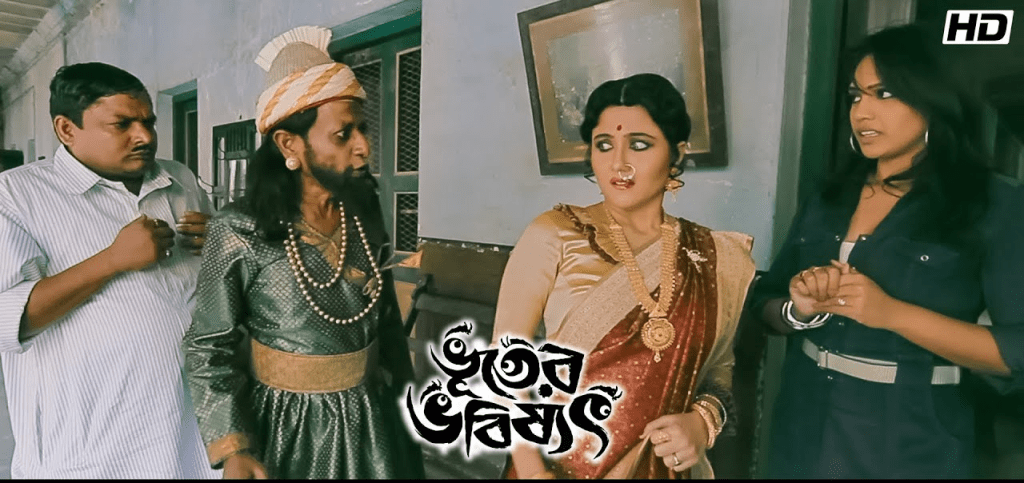
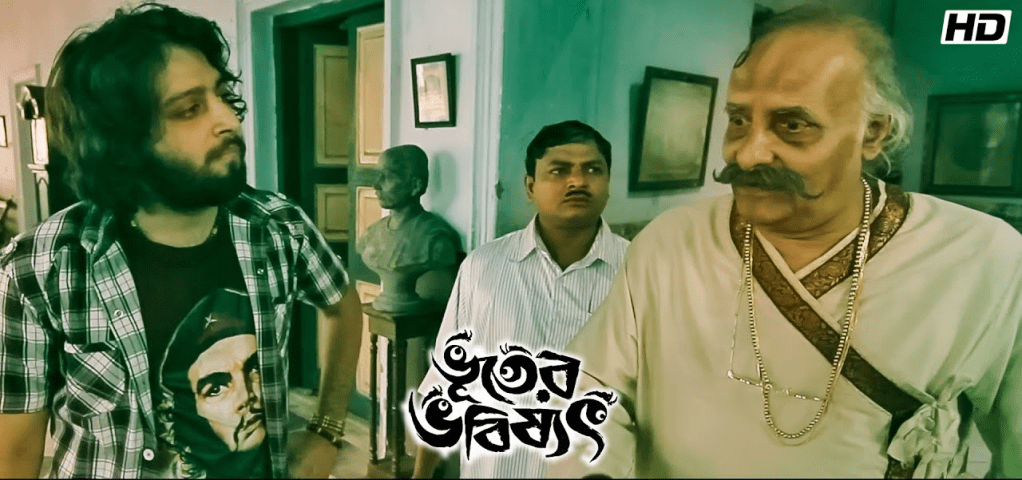
The film is structured around the director himself as the main character, narrating how he found inspiration for the story. Montage shots seamlessly bridge the past and present of the house, creating an eerie atmosphere of unknown eyes observing the new visitors through suspenseful black-and-white hazy shots. Mid shots dominate, crucial for establishing the setting. Scenes involving only spirits are filmed at a slight lopsided angle, signifying their parallel world, while those with human interaction are depicted with straight-cut angles, grounding them in reality.
The film touches upon many critical topics but especially neoliberalism and urbanisation. Though in the initial scenes we witness disparities like caste being a major issue of Hierarchy or religious differences being a major source of conflict, the latter part reveals a more harmonious coexistence among the Spirits. Though it still fazes the audience when we witness the Zamindar treating the Bihari Rickshaw puller in a manner he was used to 200 years ago and it is still accepted in the present day. The film is a symbol of the lost Heritage Of Bengal and it’s a unique twist on diversity, inclusivity, tradition, and diversity of culture and modernism. Chowdhury Mansion is personified as a utopia with an inclusive atmosphere. This is a place where upper cast and zamindars go on a picnic with a Muslim chef and an Indian officer shares a drink with a British colonizer. This is the place where the legendary elder actress learns the style and fashion of the modern world from Koyel who is from the current generation. They stand in the face of evil together to save the mansion.
Although the focus of the script is the evils of reckless real estate development, there is also a sub-theme of women’s issues in the script. Kodalibala, the legendary actress in the script, shares a similar past of being betrayed by men with almost all women in the film. She was left by her lover who gets married to a “more respectable” and “more marriageable ” girl from upper-class Bengali society. Kodalibala symbolises the pointer view of classic Bengali cinemas where women are considered impure and not eligible for marriage to upper-classmen. The last female character is the assistant director of Ayan, who symbolised the struggle of women in the industry in the present time as well. Koyel shares a similar fate when it is revealed that her gym instructor lover vanished with a huge sum of money from her father to marry a rich foreign girl in Australia.


In addition, there is the minor character, Laxmi, the deceased wife of the malevolent real estate tycoon. She met a tragic fate, burned alive due to dowry demands. This grim reality is starkly depicted in an “item song,” where seemingly suggestive lyrics actually narrate her demise with unsettling clarity. Despite the song’s veneer of sexual innuendo, its lyrics poignantly reflect the harrowing truth of Laxmi’s death. Each female character in the film holds a pivotal role in the narrative.
The last aspect of the film is the music. The music director of the film Raja Narayan Dev created the playlist which can influence every genre possible starting from Rabindra Sangeet, pop, Rock, Jazz, and qawwali, which is synonymous with different eras of the characters.
At the outset of the film, the opening song articulates the central dilemma of the plot. As historic mansions succumb to the wrecking ball, making way for modern symbols of progress and wealth at the hands of greedy developers, the film shifts the focus from human tenants to the spirits residing within. The film aims to protest the destruction of these haunted houses, shedding light on the struggles of the ghostly inhabitants.
Though so many characters from so many periods are bound to clash, harmony is also introduced through music at first. The first bonding among the ghosts is between Ramsay Saheb and Pablo the young musician through a song, which though originally composed in English, also has a modern Bengali version.
Several scenes establish a connection to the past through evocative background music. For instance, the extravaganza of Durga Puja is portrayed with the resonant beats of Dhaak drums, while the sounds of Nawazi dancers’ tinklers evoke memories of performances for zamindars in bygone eras. Each assertion of truth is underscored by appropriate sound cues, such as Ayan’s observation about the presence of ghosts in an old place, emphasized by a dolly shot and interrupted by his ringtone, featuring Satyajit Ray’s iconic music. This intervention strikes a nostalgic chord with the predominantly Bengali audience, enhancing their engagement with the narrative. Suspenseful background music heightens the storytelling sessions, intensifying the audience’s senses.
As a Bengali, the film remains one of the greatest to date. It is easy to connect deeply with the film, resonating with its nostalgic themes and artistic approach. The audience share the critical view with the makers regarding the reckless and corrupted development and demolition of heritage properties across the state. The narrative of fictional evil characters being taught a lesson by the “spirits” of these properties is exciting, yet the viewers recognize the portrayal of how these corrupted property dealers are also influenced by local political parties due to ransoms. This film holds a firm place on their all-time favorite list, offering endless discoveries with each rewatch. Through a critical analysis, the viewers can acknowledge the importance of narrative technique in guiding the audience through the complex plot and diverse settings.
 Tulii Lens