Featured

Film Appreciation: Bhooter Bhabishyat (2012)

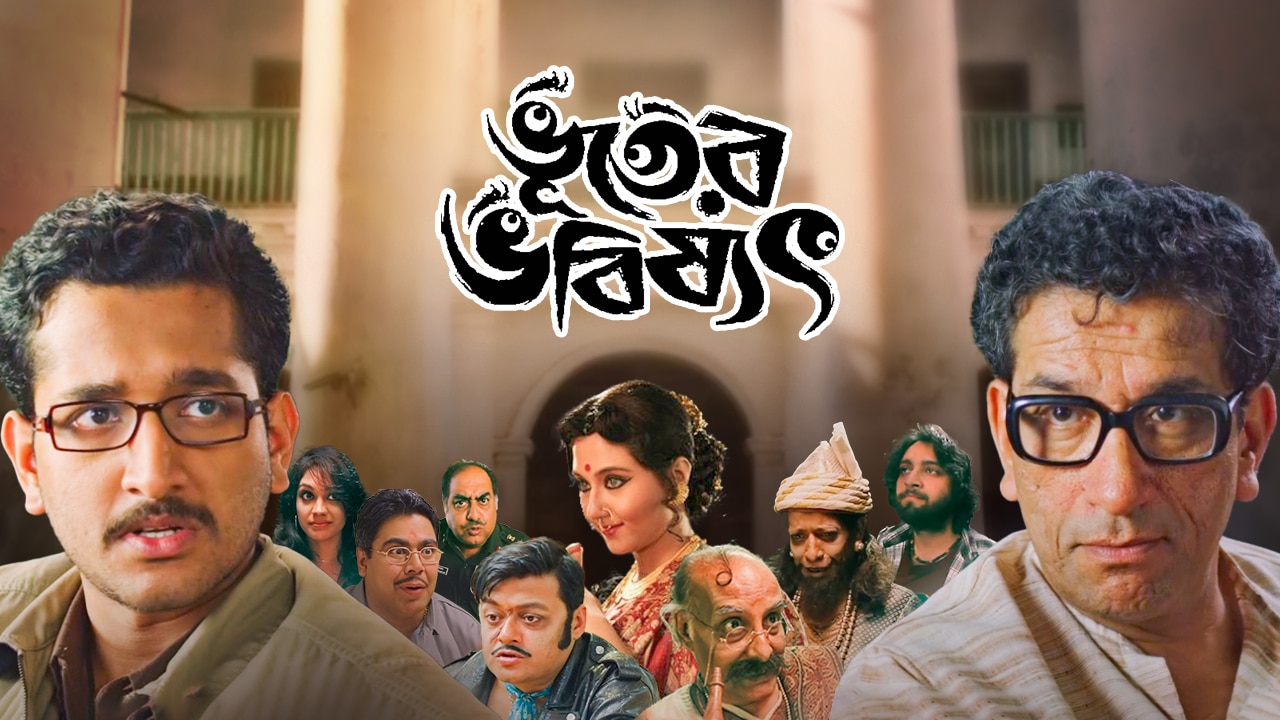
The 2012 Bengali Tollywood film shot to fame thanks to its unconventional plot, horror-comedy concept, and superb directing. Sabyasachi Chakrabarty, Parambrata Chatterjee, Paran Bandopadhyay, Swastika Mukherjee, Sumit Samaddar, Biswajit Chakraborty, Mir Afsar Ali, Saswata Chatterjee, Sreelekha Mitra, and Samadarshi Dutta are among the glamorous cast members.

The movie opens with advertising director Ayan Sengupta touring a mansion-like residence in search of a fresh place to film an upcoming commercial. When an actress passed out while filming in the same estate, word spread that the mansion is haunted. She claimed to have seen an unidentified woman’s reflection in the mirror when she regained consciousness. 

Even though Ayan wants to make his film, he lacks the funds to do so. Ayan begins exploring the estate when he is left on his own to wait for the camera director. He drifts off to sleep in an antique-filled chamber before being woken up by a man. After learning about Ayan’s job and his desire to make an original film but missing the necessary cash and an interesting plot and storyline, the man begins talking to Ayan and tells him a scenario that could work as the premise for his feature film.

The story opens with a fascinating and unusual topic: spirits of the dead that continue to haunt the planet. The speaker argues that the city’s culture and legacy are being destroyed by developers who are tearing down historic mansions and homes to make way for multiplexes, creating a crisis of housing for ghosts. It’s interesting to see that worries about food, amusement, and security extends to the souls of the dead. Thus, the audience is instructed to consider this specific mansion—where Ayan is, for instance—as the focal point of the narrative.

The Chowdhury Mansion, the story’s focal point, is haunted by its previous owner, as he chose to make it his permanent home after his death at the hands of dacoits. A call for ghosts to occupy the abandoned Chaudhary mansion was made by the Zamindar and the other spirit of a British officer serving in pre-independence India who was killed by a bomb thrown by a freedom fighter. However, due to the enormous number of applicants for a room at the house, the pair decided to choose applicants via an interview board!The candidates chosen are the Royal Cook of Siraj-ud-Daulah, who lost his life in the Battle of Plassey; an actress and singer from the 1940s who killed herself after her producer boyfriend left her and married someone else; an Indian army officer who died in the Kargil War; a singer from a Bangla rock band who overdosed; a Hindu refugee from Bangladesh who perished during the partition by a train accident; a Bihari Rikshawala killed by a reckless driver; and, lastly, a modern-spoiled rich girl who killed herself by jumping off an apartment after her Industrialist father forbade her to marry a person of a different religion. There is also the mention of a distant relative of the Chaudhary Zamindar whose spirit took shelter in the Mansion after he was killed in the Naxalite era;his death and face are not revealed to the audience. 

The circumstances, living conditions, periods of residency, and even professions of the selected candidates vary significantly. But the fact that they all passed very suddenly and in an unusual way unites them all. The initial phase of the story unfolds as the ghosts acquaint themselves with life in the Chowdhury mansion, leading to initial conflicts stemming from their differences. Amidst the chaos and clashes among the residents, the mansion transforms into an amusing pandemonium. Despite the tumultuous beginning, the spirits gradually find a chaotic harmony in settling down within the house. Yet, tranquility is short-lived when a plot dealer endeavors to demolish the mansion to erect a shopping mall on its grounds. Now, the ghosts must unite to devise a plan to preserve the mansion, their sole haven and refuge in the afterlife. 

The character of the director is the voice who narrates the scenario and setting to the audience. In the very first scene, the location of the house is revealed by the character of the actress who fainted from ghost sighting: an old house in Northern Calcutta which is a Heritage site. In reality, it is the 250-year-old Shrerampore Rajbari, known for its exquisite architecture, mystical ambiance, and rustic surroundings. The house is depicted as a character in its own right, evolving alongside its residents over the years.

The first scene starts with an actress in heavy costume jewelry which is very synonymous with Bengal society and stereotypical look. The theme of some things suspicious and unseen is settled in the first scene where the actress passes out after seeing something unseen in the mirror during a shot. 

The house is a setting of a culmination of different periods. When Ayan is taking a tour of the house, he stumbles upon various antique artifacts from different time periods in the house, though the conditions are very neglected. It is indeed a perfect setting for a group of ghosts from different time periods. Ayan Describes the setting as a “Time wrap”, which is indeed true. This creates the perfect Mise en scene.

Throughout the film, the audience is primed with expectations, such as the existence of hidden treasure in the house, rumored to be British-era coins. These expectations are confirmed when the ghosts offer the treasures to Ayan, urging him to shed light on their plight through his film. 

Interestingly, the storyline Ayan intended to adapt into a film becomes condensed into the backstory of a single character, the Bangla band musician ghost, which Boplob rightly concludes as “ a new wine in an old bottle”. This subtle critique hints at the industry’s lack of creativity, positioning the film as a refreshing original.

Each new character introduction in the film employs a distinct editing style and filter to evoke a specific period. Director Ayan’s character narrates his intentions, offering viewers an insider’s glimpse into his creative process. The scenes featuring the oldest spirit, Darpanarayan Chowdhury, are tinted with a red filter, while a black frame closing shot creates a cinematic effect within the viewer’s screen. Ramsay Saheb, the British officer, is portrayed with a vintage gray filter overlaid with a hint of yellow, contrasting with Darpanarayan Chowdhury’s era. Kadalibala, the jilted actress, is depicted in black and white, reflecting the rise of Bioscope cinema, with her comical accent edited to resemble an old recorder playing. Despite her eerie entrance into Chaudhary Palace against a grayscale night sky, the scene balances humor and creepiness with the help of music and dialogue. Narrator Biplob’s era is shot in black and white with shaky, jerky movements, capturing the turmoil of the Naxalite period.

When Biplob Das Gupta’s story and demise are recounted, his death scene is notably omitted, piquing viewers’ curiosity and hinting at a deeper significance. This omission serves as a subtle indicator that his death holds greater meaning yet to be unveiled. The symbolic significance of Biplob’s name, meaning “revolution” in Bengali, adds layers to the intrigue, suggesting that his presence may not be easily discerned, a notion underscored by the wordplay.  As the director inquires about Biplob’s presence within the narrative, viewers receive further confirmation that the narrator is indeed the departed Biplob’s spirit. Ultimately, the narrator unveils his own scene in a dramatic revelation, confirming his identity as the storyteller guiding Ayan through the tale.

The comedic essence is accentuated by the interview board set-up to assess the worthy ghostly candidates at Chaudhary Palace. Each ghost character remains true to their former selves, while the background music captures the chaotic ambiance of the interview hall, featuring a blend of languages, military tunes, and whimsical instruments. Even the ghosts themselves are bewildered by each other’s antics and personalities. Interestingly it is shown that the spirits carry their early bodily problems in the afterlife as well, be it having a weak stomach to handle spicy meals or suffering from arthritis, which makes it difficult to haunt tall trees.

For the Bhoot Chaturdashi or the Holy Night of the Ghost, the cultural festival hits a nostalgic nerve among the audience with its word alterations of famous songs to present a comical effect. In the fashion show organized by the ghosts, every character is dressed as the opposite of their nature, which shows that in the afterlife you can be anyone. And though there may be differences among the spirits in their haunting habitat, there is no such difference in the afterlife.

The most amusing aspect of the film is the dialogues and its amazing take on language. Nearly every character delivers dialogue in rhythmic cadences, with humor often subtle and situational. While literary and political references abound, language plays a pivotal role in the film’s comedic appeal. Witty exchanges, puns, wordplay, innuendos, oxymorons, poetic dialogue, and alliterations abound, harnessing the power of language to evoke laughter. The ghost characters remain true to their identities; for instance, the Naxal leader’s heavy dialogue reflects his communist mindset. A highlight of the film is its title, which cleverly plays on the word “Bhoot” in Bengali, meaning both “ghost” and “past.” Thus, the title can be translated as “future of the past,” adding an additional layer of depth to its meaning.

Though the film spectacularly accommodates so many ears in a single timeline, the costume plays a crucial role. The attire of the human characters in the film exudes a nostalgic yet realistic charm. Ayan’s assistant director, Rinka, embodies the quintessential Bengali thinker and creative individual, sporting a blend of traditional clothing with modern elements like jeans and a tote bag. Meanwhile, Ayan, the director, is easily recognizable in his signature khaki jacket. Similarly, the ghostly characters from different periods also have the perfect costume from their era. Though for their case, only a single costume is used for each, i.e, the one in which they died. What intrigues the most is the costume design of the characters. While the situation demands meticulous research into costumes, furniture, and props, the film effectively utilizes single outfits that seamlessly blend into the narrative. This serves as a testament to the notion that a well-crafted potboiler can excel with the right recipe and setting.
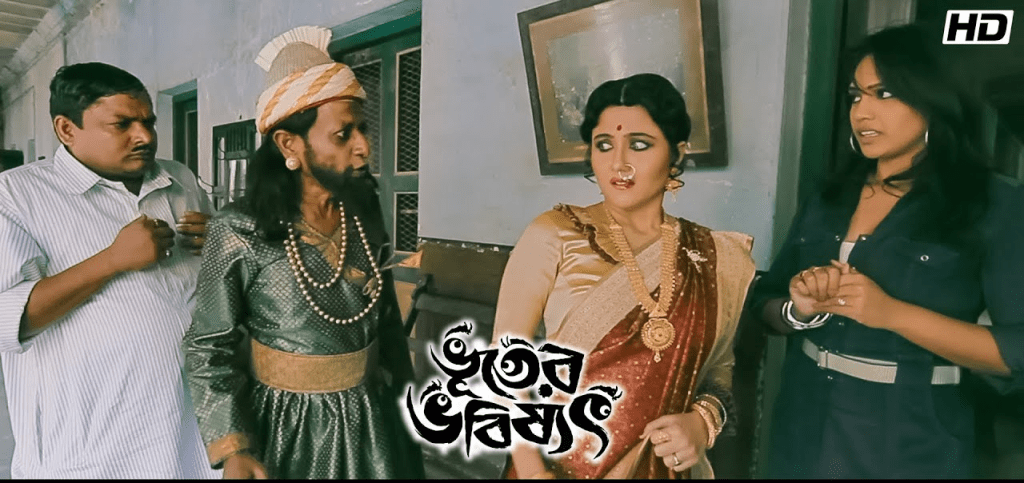
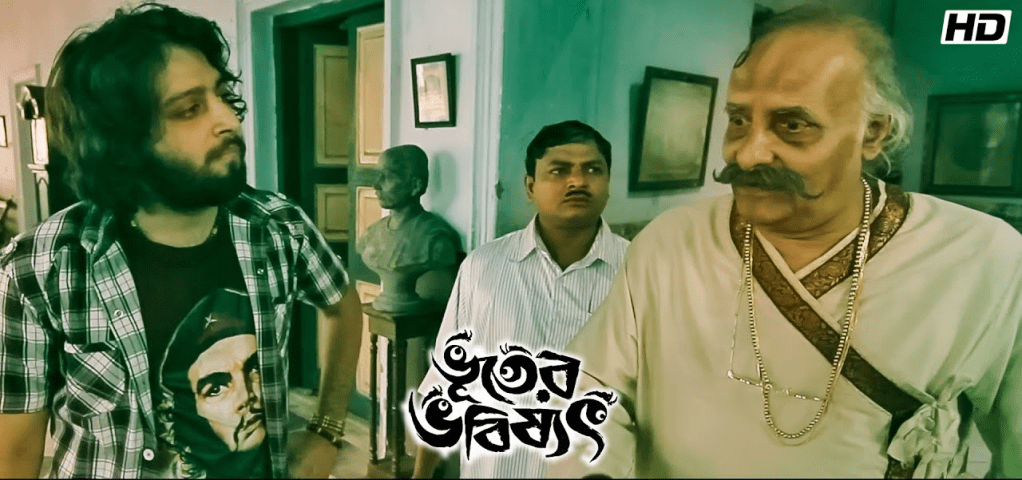
The film is structured around the director himself as the main character, narrating how he found inspiration for the story. Montage shots seamlessly bridge the past and present of the house, creating an eerie atmosphere of unknown eyes observing the new visitors through suspenseful black-and-white hazy shots. Mid shots dominate, crucial for establishing the setting. Scenes involving only spirits are filmed at a slight lopsided angle, signifying their parallel world, while those with human interaction are depicted with straight-cut angles, grounding them in reality.

The film touches upon many critical topics but especially neoliberalism and urbanisation. Though in the initial scenes we witness disparities like caste being a major issue of Hierarchy or religious differences being a major source of conflict, the latter part reveals a more harmonious coexistence among the Spirits. Though it still fazes the audience when we witness the Zamindar treating the Bihari Rickshaw puller  in a manner he was used to 200 years ago and it is still accepted in the present day. The film is a symbol of the lost Heritage Of Bengal and it’s a unique twist on diversity, inclusivity, tradition, and diversity of culture and modernism. Chowdhury Mansion is personified as a utopia with an inclusive atmosphere. This is a place where upper cast and zamindars go on a picnic with a Muslim chef and an Indian officer shares a drink with a British colonizer. This is the place where the legendary elder actress learns the style and fashion of the modern world from Koyel who is from the current generation. They stand in the face of evil together to save the mansion. 

Although the focus of the script is the evils of reckless real estate development, there is also a sub-theme of women’s issues in the script. Kodalibala, the legendary actress in the script, shares a similar past of being betrayed by men with almost all women in the film. She was left by her lover who gets married to a “more respectable” and “more marriageable ” girl from upper-class Bengali society.  Kodalibala symbolises the pointer view of classic Bengali cinemas where women are considered impure and not eligible for marriage to upper-classmen. The last female character is the assistant director of Ayan, who symbolised the struggle of women in the industry in the present time as well. Koyel shares a similar fate when it is revealed that her gym instructor lover vanished with a huge sum of money from her father to marry a rich foreign girl in Australia.

In addition, there is the minor character, Laxmi, the deceased wife of the malevolent real estate tycoon. She met a tragic fate, burned alive due to dowry demands. This grim reality is starkly depicted in an “item song,” where seemingly suggestive lyrics actually narrate her demise with unsettling clarity. Despite the song’s veneer of sexual innuendo, its lyrics poignantly reflect the harrowing truth of Laxmi’s death. Each female character in the film holds a pivotal role in the narrative.

The last aspect of the film is the music. The music director of the film Raja Narayan Dev created the playlist which can influence every genre possible starting from Rabindra Sangeet, pop, Rock, Jazz, and qawwali, which is synonymous with different eras of the characters.

At the outset of the film, the opening song articulates the central dilemma of the plot. As historic mansions succumb to the wrecking ball, making way for modern symbols of progress and wealth at the hands of greedy developers, the film shifts the focus from human tenants to the spirits residing within. The film aims to protest the destruction of these haunted houses, shedding light on the struggles of the ghostly inhabitants.

Though so many characters from so many periods are bound to clash, harmony is also introduced through music at first. The first bonding among the ghosts is between Ramsay Saheb and Pablo the young musician through a song, which though originally composed in English, also has a modern Bengali version. 

Several scenes establish a connection to the past through evocative background music. For instance, the extravaganza of Durga Puja is portrayed with the resonant beats of Dhaak drums, while the sounds of Nawazi dancers’ tinklers evoke memories of performances for zamindars in bygone eras. Each assertion of truth is underscored by appropriate sound cues, such as Ayan’s observation about the presence of ghosts in an old place, emphasized by a dolly shot and interrupted by his ringtone, featuring Satyajit Ray’s iconic music. This intervention strikes a nostalgic chord with the predominantly Bengali audience, enhancing their engagement with the narrative. Suspenseful background music heightens the storytelling sessions, intensifying the audience’s senses.

Suspended Honeycomb Jute Cradle System for Premium Mango Exports

MINISTRY OF COMMERCE & INDUSTRY
Government of India

INDIAN INSTITUTE OF PACKAGING (IIP)

In collaboration with

National Jute Board
Ministry of Textiles
Government of India

HACKATHON ON

Sustainable Jute Based Packaging Solutions

for Premium Horticultural Produce

Submitted By

Ellora Sinha Independent Researcher & Design Strategist

1.3.2026

Suspended Honeycomb Jute Cradle System for Premium Indian Mango Exports

1. Executive Summary  

India is the world’s largest producer of mangoes, contributing approximately 40–45% of global mango production, with annual production estimated between 20–25 million metric tonnes (FAOSTAT, 2023; APEDA, 2023). Despite this dominance, India exports less than 1% of its total production annually, typically in the range of 20,000–30,000 metric tonnes (APEDA, 2023).

Premium varieties such as Alphonso and Kesar command strong demand in key export markets including the UAE, UK, USA, Qatar, and EU nations (APEDA, 2023). However, current export packaging systems rely heavily on corrugated fiberboard cartons combined with molded pulp trays, foam nets, and plastic liners. These systems present limitations in bruise prevention, compression load transfer, airflow management, and sustainability compliance.

With increasing regulatory pressure in EU and UK markets for plastic reduction under extended producer responsibility (EPR) frameworks and packaging waste directives (European Commission, 2022), there is a clear opportunity to innovate sustainable, structurally superior export packaging systems.

This proposal introduces a Modular Suspended Honeycomb Jute Cradle System, designed to:

  • Minimize bruising through fruit suspension
  • Reduce reliance on foam nets and plastic cushioning
  • Improve airflow and natural ripening during transit
  • Align with sustainability regulations in importing countries

2. Industry Context & Problem Statement

2.1 India’s Mango Export Landscape

  • India contributes ~40–45% of global mango production (FAOSTAT, 2023).
  • Major producing states for premium varieties include:
    • Maharashtra (Alphonso)
    • Gujarat (Kesar)
    • Uttar Pradesh (Dasheri)
    • Andhra Pradesh (Banganapalli)
    • West Bengal (Himsagar) (APEDA, 2023).

Despite production dominance, export volumes remain relatively low compared to total output. Export constraints include:

  • Strict phytosanitary standards (USDA APHIS, 2022).
  • High rejection rates due to bruising and fungal spoilage.
  • Packaging-related compression damage during long-haul logistics.

2.2 Current Export Packaging Systems

Premium mango exports typically use:

  1. Corrugated Fiberboard (CFB) cartons
  2. Molded pulp trays
  3. Foam net sleeves
  4. LDPE liners for moisture control
  5. Ventilated carton designs

Corrugated packaging is widely used due to stack strength and recyclability (Singh & Reddy, 2017). However:

  • Mangoes rest on rigid pulp trays → pressure points form.
  • Vertical stacking transfers compression load through fruit layers.
  • Foam nets (polyethylene-based) are widely used but contribute to plastic waste.
  • LDPE liners restrict airflow and increase condensation risk.

2.3 Sustainability & Regulatory Pressures

EU and UK markets are increasingly regulating:

  • Non-recyclable plastics
  • Expanded polystyrene (EPS)
  • Excessive single-use packaging

Under the EU Packaging and Packaging Waste Directive (European Commission, 2022), exporters are encouraged to shift toward recyclable and biodegradable materials.

This creates a design opportunity for jute-integrated systems.

3. Project Objectives

  1. To analyse structural and functional gaps in current premium mango export packaging.
  2. To design a suspended fruit-support system using jute-based cradles.
  3. To develop a modular sliding tray box architecture that prevents compression damage.
  4. To align the solution with sustainability and export compliance requirements.
  5. To establish a validation roadmap with IIP for compression and vibration testing.

4. Proposed Innovation: Suspended Honeycomb Jute Cradle System

4.1 Concept Overview

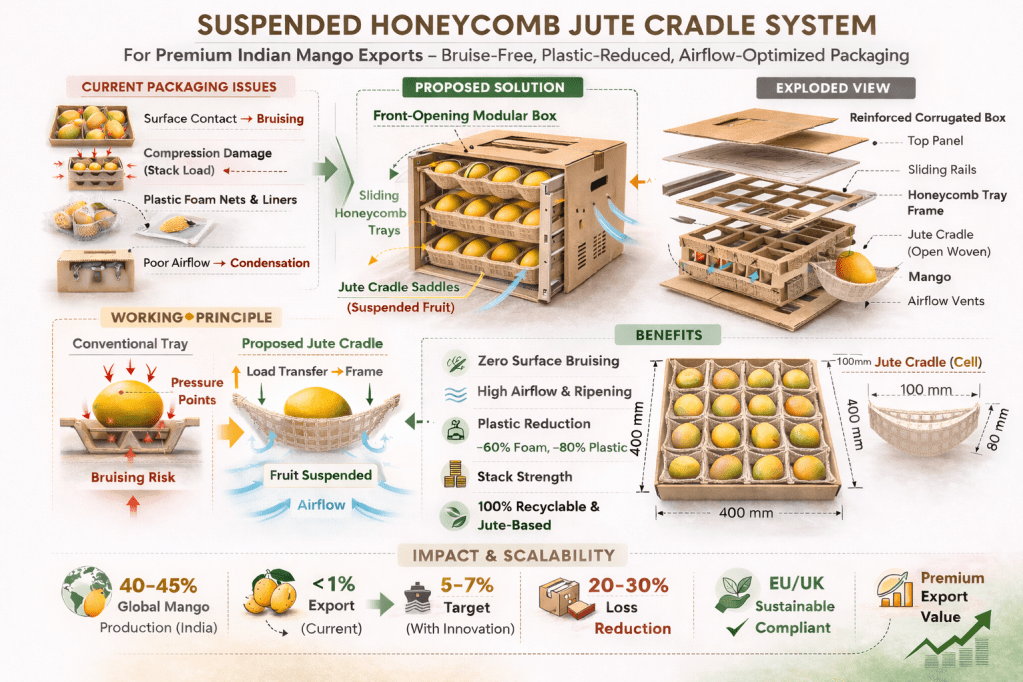
The proposed system consists of:

A. Modular External Box

  • Reinforced corrugated fiberboard structure.
  • Front-opening configuration.
  • Integrated sliding rails for tray insertion.

B. Sliding Honeycomb Trays

Each tray includes:

  • Rigid honeycomb grid partitions.
  • Slide-in rail compatibility.
  • Stackable multi-layer configuration.

C. Jute Suspension Cradle Saddles

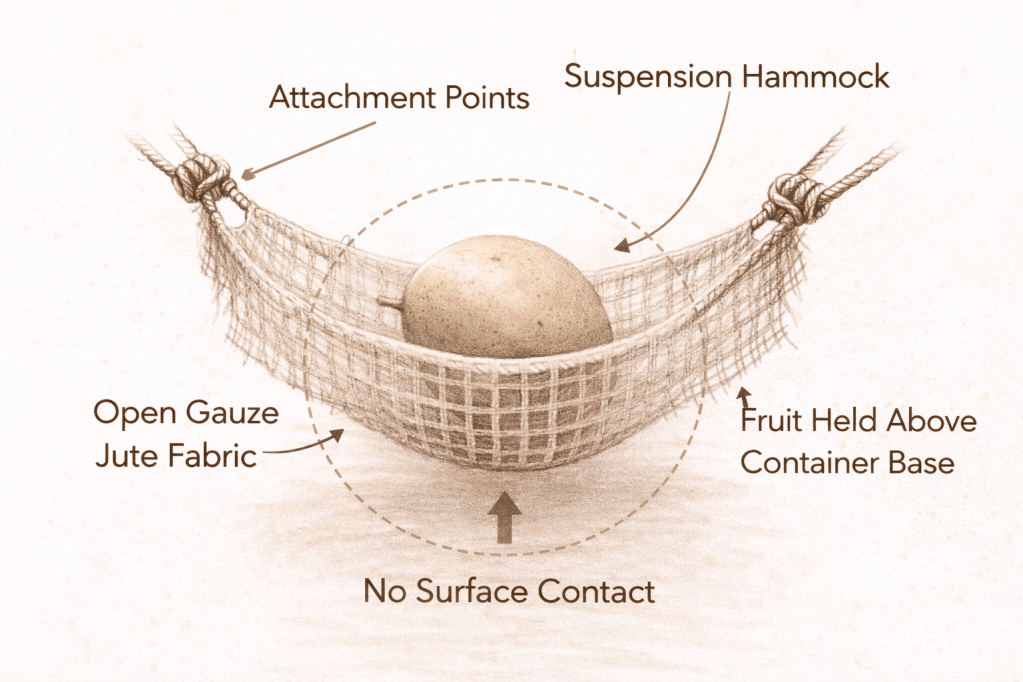
Each grid cell contains a soft, open-weave jute cradle anchored at four points.

Functional Mechanism:

  • Mango remains suspended rather than resting on a rigid surface.
  • Compression loads are transferred to tray frame edges.
  • Open weave enables natural airflow around the entire fruit surface.

Image 1: Jute hammock cradle system for individual fruit

D. Structural Load Logic

Unlike conventional systems where fruit bears stacking load, this design ensures:

  • Frame-to-frame vertical load transfer
  • Fruit remains mechanically isolated
  • Reduced bruise incidence

Image 2: Diagram of the Suspended Honeycomb Jute Cradle System

5. Innovation & Novelty

The innovation lies in:

  • Transition from surface-support to suspension-support packaging.
  • Replacing polyethylene foam nets with breathable jute cradles.
  • Integrating sliding modular trays for inspection and premium handling.
  • Designing load-bearing frames separate from fruit support.

This positions jute as a structural and protective material rather than merely a bulk sack textile.

6. Commercial Feasibility

6.1 Manufacturability

  • Jute cradle components can be stitched through existing jute clusters.
  • Honeycomb partitions can be produced via modified corrugated die-cut systems.
  • Box production remains compatible with standard Corrugated Fibre Board lines.

6.2 Market Alignment

Target segment:

  • Premium mangoes like Alphonso, Himsagar and Kesar exporters
  • Air freight and controlled sea freight consignments
  • Sustainability-focused retailers in EU/UK

6.3 Competitive Advantage

  • Reduced fruit rejection rates
  • Sustainable branding differentiation
  • Plastic reduction compliance

7. Expected Impact

Environmental

  • Reduction in polyethylene foam nets.
  • Reduced plastic liner dependency.
  • Increased biodegradable material share.

Economic

  • Lower bruising losses (post-harvest loss in mango can reach 20–30% in supply chains; NCCD, 2021).
  • Higher premium export value realization.

Strategic

  • Strengthens India’s premium mango export positioning.
  • Integrates jute into high-value horticultural packaging systems.

8. Validation Roadmap

  • Compression strength testing (IIP)
  • Vibration simulation
  • Moisture and airflow analysis
  • Cost comparison vs current molded pulp systems
  • Export pilot with West Bengal /Maharashtra/ Gujarat exporters

9. Conclusion

India produces nearly half of the world’s mangoes but captures limited export value. The Suspended Honeycomb Jute Cradle System presents a scalable, structurally sound, and sustainability-aligned packaging innovation tailored for premium mango exports.

By preventing surface bruising, reducing plastic use, and enhancing airflow, this system directly addresses export loss, regulatory pressure, and premium branding opportunities.


References

  • APEDA (2023) Mango Export Data and Market Profile. Agricultural and Processed Food Products Export Development Authority, Government of India.
  • European Commission (2022) Packaging and Packaging Waste Directive (PPWD). Brussels: European Union.
  • FAOSTAT (2023) FAO Statistical Database – Mango Production Data. Food and Agriculture Organization of the United Nations.
  • NCCD (2021) Post-Harvest Losses in Fruits and Vegetables in India. National Centre for Cold-chain Development, Government of India.
  • Singh, Z. and Reddy, B. (2017) ‘Postharvest physiology and storage of mango’, Stewart Postharvest Review, 13(3), pp. 1–12.
  • USDA APHIS (2022) Import Requirements for Fresh Mangoes. United States Department of Agriculture.

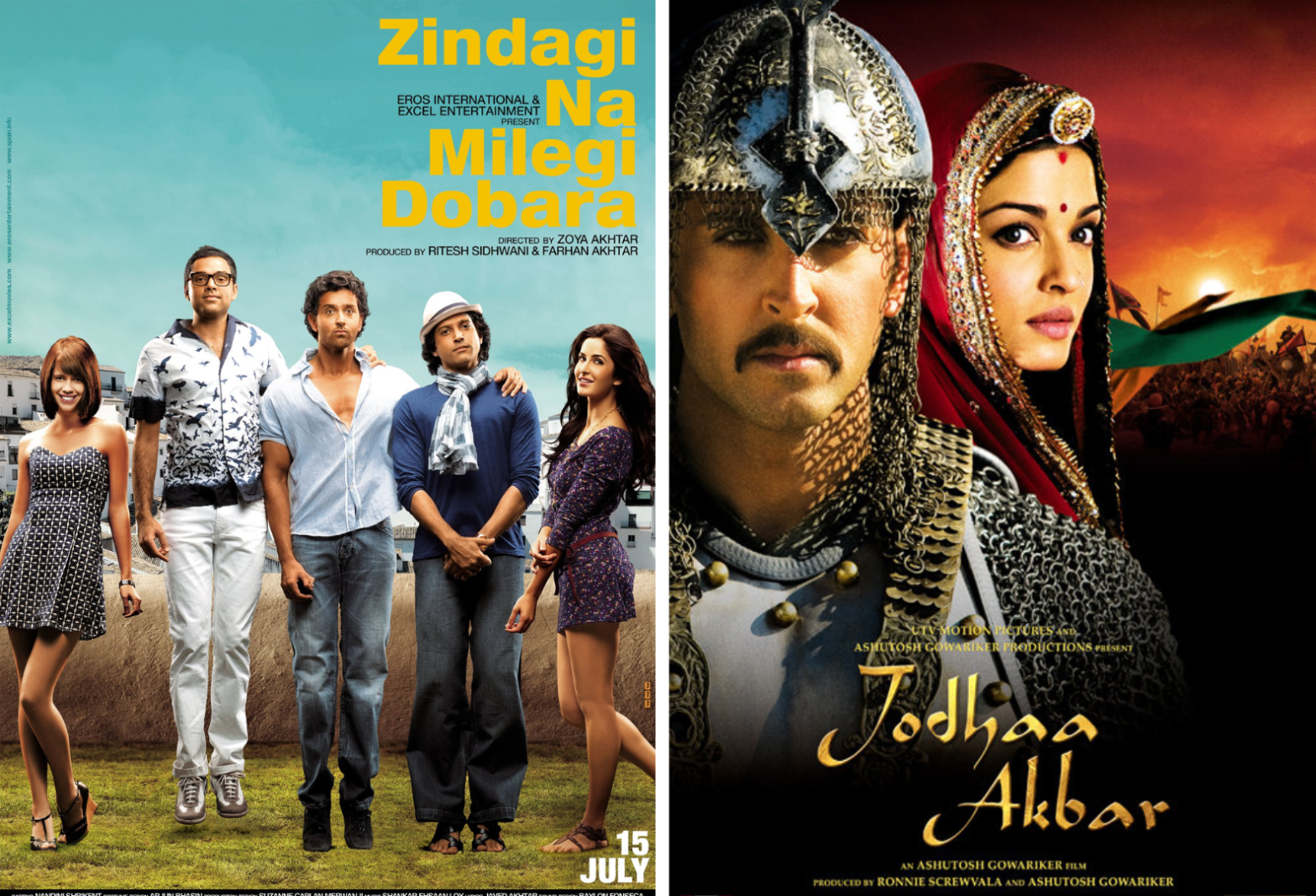
Exploring Hrithik Roshan’s Versatility: A Comparative Analysis of His Roles in “Zindagi Na Milegi Dobara” and “Jodhaa Akbar”

In “Jodhaa Akbar,” the film incorporates traditional Sufi-based music to create a mystical, powerful atmosphere with a touch of historical authenticity. In contrast, “Zindagi Na Milegi Dobara” features bass-heavy instrumentals to evoke a feel-good, contemporary vibe.

Nykaa: A Study on Omnichannel Experience and Marketing Strategy

Nykaa, an Indian e-commerce company established by Falguni Nayar in 2012 and based in Mumbai, specializes in selling beauty, wellness, and fashion products. The company operates through its website, mobile app, and more than 100 physical stores. To gain insight into the brand’s remarkable success, five key questions are explored, focusing primarily on its marketing strategies and presence across various platforms. The study was done in 2022 as per the data available. 

Nykaa’s success story: what are the key differentiating factors that set Nykaa apart from its competitors

Nykaa’s founder, Falguni Nayar, recognized several inconsistencies in the beauty product market in India. Despite high demand, the Indian cosmetic market lagged behind international markets like those in France and Japan, and products were not widely available throughout the country. This gap led to the creation of Nykaa. Initially launched as an online platform, Nykaa later adopted an omnichannel strategy. By focusing specifically on cosmetics, Nykaa differentiated itself from e-commerce giants like Amazon, Flipkart, and Myntra, establishing itself as a one-stop shop for beauty products.

Nykaa’s emphasis on customer service and capital efficiency has been a standout feature in the Indian e-commerce sector, as noted by Ravi Mehta, founder and CIO of Steadview Capital. The company’s dedication to authenticity and customer experience has attracted over 8 million customers. Nykaa’s effective social media strategy, which covers all aspects of beauty, has significantly contributed to its success. The company educates its customers about the unique selling points of various products and offers personalized recommendations to instill confidence in their purchases. Nykaa’s helpline also assists customers in selecting products and services tailored to their needs, emphasizing the brand’s mission to make ordinary women extraordinary.

Nykaa’s core mission is built on three principles: curation, information, and personalization. During the COVID-19 pandemic, despite beauty products not being classified as essential, Nykaa quickly adapted by launching a line of everyday essentials. This adaptability allowed Nykaa to survive and thrive during challenging times. Falguni Nayar explained that the company pivoted to an essentials-only online store and leveraged its 70 offline stores for hyperlocal delivery, matching online orders with in-store availability to serve nearby customers. This strategy helped manage Nykaa’s warehouse and inventory effectively, especially when air conditioning was shut down in many shopping malls, making it crucial to shift stock from stores to warehouses.

Nykaa’s rapid adaptation to changing circumstances and its quick responses to market needs have solidified its success in the e-commerce retail world.

Digital marketing strategy of Nykaa: types of digital marketing used  to communicate with the target audience

A key factor in Nykaa’s business success has been its adept use of social media platforms to establish itself as a reputable voice in beauty and fashion. Freya D’Souza, Assistant Vice President of Strategy at Dentsu Webchutney, a digital advertising agency, highlights that community-building is crucial for a brand to excel on social media. Nykaa aims to create engaging content, particularly through videos, that resonates with their audience. Their how-to videos and beauty tips on YouTube and Instagram cater to beauty enthusiasts who avidly create and consume online content. The brand not only targets Tier 1 cities but also reaches potential customers in Tier 2, 3, and 4 cities.

Social Media Marketing: Nykaa operates four main social media accounts: My Nykaa, Nykaa Beauty for promoting its e-commerce platform, Nykaa Fashion for its apparel store, and Nykaa Beauty Book, which provides beauty and makeup tips. The brand leverages influencer marketing on these platforms to enhance engagement and boost promotions.

YouTube Marketing: Nykaa’s YouTube strategy focuses on providing valuable content rather than directly selling products. Their channel features beauty tips, personal care advice, makeup hacks, and more, tailored to their audience. They also use targeted YouTube ads to reach specific customers, maintaining a robust marketing strategy through relevant ads and high-quality content.

Content Marketing: Content marketing is a major component of Nykaa’s strategy. The brand produces highly consumable content that resonates with its audience, leading to significant customer conversions. Through their blog, “Nykaa Beauty Book,” they offer articles on beauty, makeup, and personal care, catering to consumer needs. Additionally, Nykaa creates video content, including makeup tutorials and DIYs, which are highly popular.

Event Marketing: Nykaa strategically taps into its audience through event marketing. The brand has sponsored the Femina Miss India event, one of India’s largest beauty events, multiple times. Nykaa also engages with college events such as the Red Brick Summit at IIM Ahmedabad and Mumbai’s Mood Indigo. They host award shows related to beauty and fashion, inviting numerous influencers, which significantly boosts the brand’s presence on social media.

By effectively leveraging these marketing strategies, Nykaa has solidified its position in the beauty and fashion industry, engaging a wide audience and driving substantial business growth.

Nykaa’s Omnichannel retail experience

In 2018, Nykaa expanded by launching a fashion vertical, followed by a men’s grooming platform, Nykaa Man, in 2019. For Nykaa, customer experience is paramount, particularly in its competition with other e-commerce giants. This approach also supports customer retention by eliminating the need for customers to repeatedly share their preferences and needs. Nykaa aims to replicate the offline shopping experience online, facilitating guided selling as shoppers often spend considerable time researching products. Through its omnichannel strategy, Nykaa has created a seamless purchase funnel from discovery to purchase using various tools.

To synchronize store operations and update master data, Nykaa implemented a point of sale solution integrated with its online retail management system, Vin eRetail. This allowed the brand to establish real-time inventory management and efficient warehouse operations. The integration also enhanced order management and processing, utilizing handheld devices for better coordination.

Nykaa’s omnichannel success is further driven by educating customers about the unique selling points of products, recommending items based on individual needs, and providing information to build confidence in their purchases. These efforts contribute to a well-curated and cohesive shopping experience across all platforms.

Nykaa’s celebrity endorsements to appeal to its target audience 

In 2018, Nykaa appointed Janhvi Kapoor as its first official brand ambassador. Despite being in her debut year, Kapoor had already amassed a significant following. Her image as a fresh, young face resonated with Nykaa’s primarily youthful target audience. By partnering with a newcomer like Janhvi, Nykaa sought to establish an independent identity and challenge the status quo, bringing a unique screen presence to the brand.

Nykaa also engages in specialized endorsements with makeup artists, beauty experts, and dermatologists to add credibility. Collaborations with brands sold on its platform for videos ensure good visibility. Additionally, Nykaa has worked with social influencers like Mallika Dua for social media campaigns and experimented with beauty tutorials to encourage viewers to try its products.

The brand has maintained a close association with Katrina Kaif, who has consistently endorsed Nykaa’s credibility through interviews and her investment in and partnership with Kay Beauty. This association has significantly boosted the brand’s reputation. Katrina’s glamorous appeal complements Nykaa’s image, while Masaba Gupta, another celebrity linked to the brand, adds a quirky touch. These personalities embody Nykaa’s unique blend of glamour and quirkiness, enhancing the brand’s distinct identity.

Nykaa’s app assessment from a customer’s perspective.

Pros:

  • User-Friendly Layout: The desktop layout is well-designed, making it easy for users to navigate.
  • Engaging Landing Page: The landing page is effectively designed to capture customer attention with deals and offers.
  • Customer Delights: Every page offers perks such as offers and gift cards, enhancing the shopping experience.
  • Proper Categorization: Clear categorization and ample buffer space improve usability.
  • Educational Content: Guides, advice, and tutorials help users, especially newcomers, learn about beauty and makeup.
  • Welcoming to New Users: The platform makes even those with little knowledge about beauty feel welcome.
  • Integrated Marketing: Easy access to other platforms like YouTube enhances marketing efforts.
  • Mobile-Friendly: The website is optimized for mobile use when accessed through a browser.
  • Seamless Integration: Both the website and app are integrated for a cohesive user experience.
  • Virtual Mirror Technology: This feature helps buyers feel more confident in their purchases.

Cons:

  • Multiple Tabs: Each landing page opens a new tab in the browser, which can be cumbersome.
  • Information Overload: The abundance of information can overwhelm newcomers and lead to confusion.
  • Missing Brand Ambassador: The brand ambassador is notably absent from the landing pages.
  • Complex Testing Parameters: The technical complexity of cosmetic testing parameters can be off-putting.
  • Inaccurate Virtual Mirror: The virtual mirror technology is not always accurate and can be glitchy.

What can be worked upon: 

Nykaa is a comprehensive destination for all things beauty and fashion through its online shop. However, for newcomers to cosmetics and beauty, the site can feel overly complicated and technical. To enhance their experience, the brand should implement steps to simplify the process. The “try it on” digital mirror offers users a preview of how products might look in real life, but it still suffers from glitches and inaccuracies. Additionally, the website should streamline the user experience by consolidating landing pages into a single tab, rather than opening a new tab for each click.

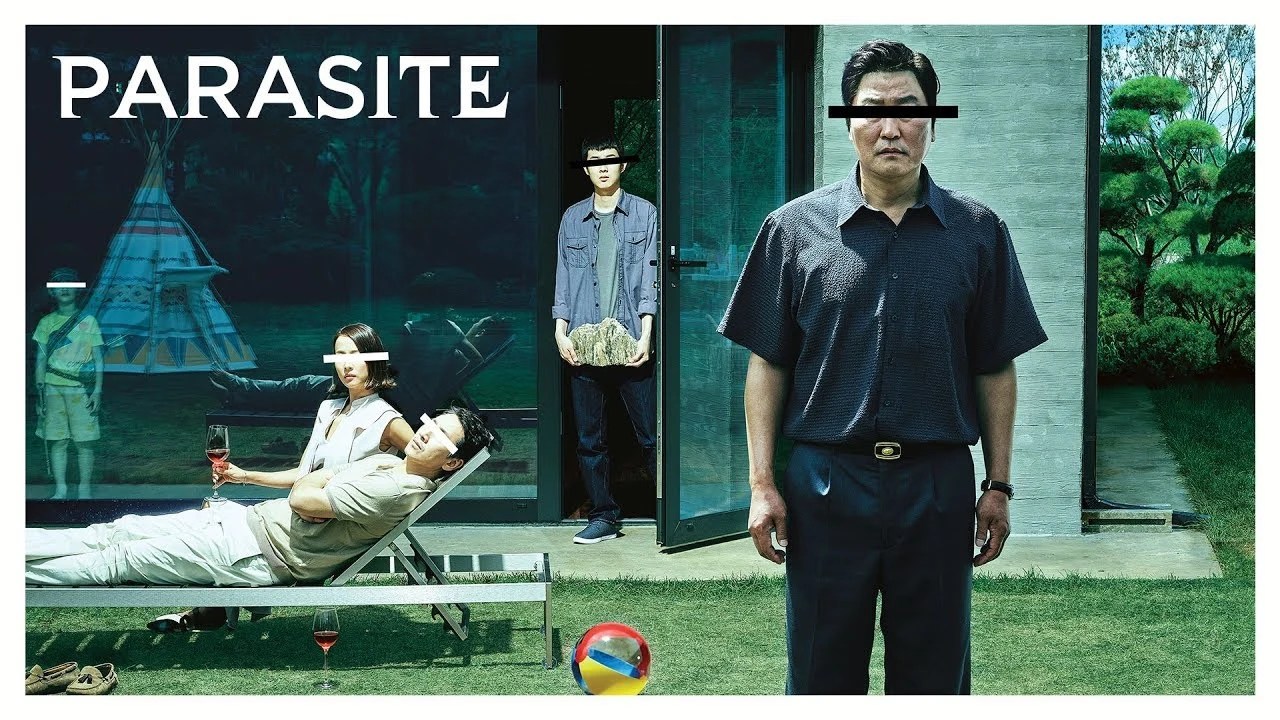
Visual Grammar: Parasite (2019)

Dove: A Brand Communication Case Study

Study and analysis of the Dove Real beauty campaign since its inception to date.

Dove is an American personal care brand owned by the British multinational consumer goods company Unilever.

Established in: 8 March 1957

Parent Company: Unilever

Category: Personal Health care

USP: Deep Moisturiser for skin

Objective of the campaign: why was it initiated? 

In February 2000, Dove was tapped to become a Masterbrand. And it needed a strong UPS to enter the market with its new series of products. Since its launch in 1957 in the United States, the primary product of Dove has been its Beauty bar. Among its other competitors, Dove Bar Soap led by a large margin. It helped Unilever to take over its biggest competition, Proctor & Gamble, and dominate the American Soap Market in 1999. However, the sales started becoming stagnant for Unilever, with P&G introducing Olay to the consumer market. The company also planned to launch a series of products and to enter this market, they needed to change their strategy. “Dove’s mission, in commissioning The Real Truth About Beauty study, was to explore empirically what beauty means to women today and why that is. Further, Dove wanted the study to assess whether it was possible to talk and think about female beauty in ways that were more authentic, satisfying, and empowering” (Etcoff, Orbach, Scott, & D’Agostino, 2004) In 2004, Dove and Ogilvy & Mather organised a photography exhibit titled “Beyond Compare: Women Photographers on Real Beauty.” The show featured work from 67 female photographers and was the beginning of the revolution in the world of beauty that would lead to the Real Beauty campaign. This, in 2004, initiated the “Real Beauty Campaign”.

Integrated Marketing Communication Approach and Communication Mix’s Impact

Before launching the actual campaign Dove needed a clear communication model from the result of the Global Research study. Target The integrated marketing target segmentation revolved solely around women including all ages, sizes, and ethnicities of women. It was important to use Integrated marketing communication because, with its broadcast, women were made aware of the unsettling beauty description in the market. Dove was able to pinpoint the basic sense of demoralisation among human beings about their natural appearance. This was only heightened by the gaps between their image and the image of perfection created by the industry. It was followed by two creative strategy approaches. The first was the rebranding strategy and the second, was a stand-out guerilla marketing campaign to create a ripple of uncomfortableness in society about a topic that people don’t feel comfortable talking about. Dove aimed for full market coverage by focusing on and reaching women from all groups. The emphasis and the highlight were not on a single product but instead on the branding message. Through undifferentiated marketing, Dove was able to execute their goal for full coverage by strategically placed tactics where the campaign is viewed by all women. Dove initially targeted women aged from 18 to 65 most of the responses from the campaign came from middle-aged women, aged between 35 to 55. These women came from the targeted consumer which consists of middle-class income families who are mostly dependent on the low end and drugstore beauty products rather than luxury high-end products. At the time the campaign was being launched there was an emerging trend of social media and Dove was able to utilise that to the advantage of marketing through YouTube and other social media platforms. They are one of the first big companies that started utilising social media before other brands followed. The product line for men was also generated from this when Dove’s real beauty campaign opened discussion and conversation about beauty involving men as well. A lot of credit goes to the brand positioning itself in the market among its competitors as well as highlighting the brand image and also creating the key factor for brand differentiation. 

Main communication channels: 

  • TV commercials 
  • Social networks (Facebook, Twitter, Instagram) 
  • Billboards 
  • Videos: Youtube

Marketing communication mix 

Advertising: The campaign was also focused on better positioning the brand in the market along with its competitors. Initial Advertisements were done through billboards and hoardings followed by social media and youtube videos. 

Sales promotions: Dove provides free samples of their products being launched in the market. Potential customers are provided with opportunities to join “ your love” which provides them with special offers. Customers are provided with expert advice and beauty tips which in turn promote Dove soap to the customers. 

Events: Dove events are especially for engaging with customers. These include regional brand-building events like a self-esteem workshop in Canada which was later turned into a film. 

Public relations: The PR highlighted the importance of inner beauty through its constant creative marketing and impactful content. These include a news section of Dove that popularised the effects of Dove products which are synonyms to the campaign message of inner beauty. 

Direct Marketing: Dove enables the facility to customer service through their toll-free number. Through the “Your Dove” campaign, customers can receive beauty tips, offers, etc. 

Interactive marketing: The real beauty campaign provided a platform for women to provide their perspective about beauty to the world. 

Word of mouth: Along with the success of the campaign at the very initial stage, people were already interacting with the content. This along with the affordable nature of the products made them even more famous among the masses. 

Social media interaction: Dove started utilising social media when it was not the convention. However, it was able to reach a greater audience and create a bigger impact with it. With relatable content about the constantly changing notion of beauty, Dove was able to tap into a topic that is relatable for all times. 

How did it differentiate the brand?  

Yes, they were able to differentiate themself from their competitors very well. In a market where a lot of focus was based on the factor of perfect beauty, Dove was able to differentiate itself with their unique perspective of focusing on real beauty. As mentioned, its position in the market at the time of the launch of the campaign played a significant role. To cater to their marketing efforts Dove was already in a position to take a point of view in culture and popular media. Dove’s differentiating point was simple yet innovative compared to its competitors. They focused on the simplicity and diversity of the products which was essentially suitable for various people coming from different backgrounds. Apart from this the implementation of the campaign strategy also stood them apart from their competitors. Rather than overwhelming their consumers with the negative feeling from traditional beauty advertising, it encouraged the consumer to accept them for themselves. It’s such a brand image in a positive light where the consumers are encouraged to feel confident in their skin. This in turn boosts brand awareness and brand loyalty. With the campaign, Dove appeared as one of the first brands to challenge and change the culture of advertising stereotypical beauty. It provided not only a fresh perspective to the media but also focused on consumer engagement through social media for expanding their brand equity. Dove was able to create an emotional response through their campaign which resonated with the majority of the population. This was aided by its vast reach through social media as well as other communication channels like YouTube videos, ads, etc. Dove was able to present itself as a company that doesn’t simply make people feel better but it was also able to reframe the actual purpose for purchasing their beauty products. Altho the actual quality and the price of the products were never Virtually mentioned in the ads throughout the actual campaign. Its unique presentation allowed women to show solidarity with the brand message simply by buying their products. The self-esteem Toolkit of Dove’s online resource includes workshops, videos, and guides aimed at building girls’ self-esteem. This in turn reflects the campaign’s mission which is to redefine beauty.

Dove’s Strategy and Brand Communication Plan: a brand communication model

With sentiments and emotions attached to the campaign from a big audience, it generated customer loyalty among its followers.

  • Brand message: Promoting “ Real beauty” 
  • Targeted audience: Women of all ages, ethnicity, race, etc. 
  • Pain points and needs: Stereotypical and unattainable beauty standards; feeling confident in one’s skin. 
  • Value proposition: Beauty comes from within, breaking beauty standards 
  • Advertising plan: Through-the-line-ads, Positioning, retention, product differentiation, social and natural appeal, Guerrilla marketing 
  • Customer response: relatable message, see reality and breaking free from stereotypes and their effects 
  • Duration: The brand is still going on through the extended version of the real beauty campaign, with its recent change in the logo color from yellow to grey to show aging is also beautiful 
  • Success metrics: Sales for Dove jumped from $2.5 to $4 billion in the campaign’s first ten years.

Dove was able to select the right message at the right time. When the industry was at the peak of highlighting impossible beauty standards, dove presented a reality check for the masses and turned it into a positive movement. The brand was able to get itself noticed at the very beginning of the campaign with its tick box campaign with live voting on billboards for different beauty notions. Their brand communication plan through the campaign is simple. “ Beauty comes from within” is a message which resonates and is well-received by almost everyone. It is not only memorable but also motivates potential customers to be influenced by the brand message. Purchasing Dove products meant showing solitary to the message itself. With a new marketing strategy, they showed “real women” in their communication which not only leaves an impression but also creates brand advocates and a love for the brand. Throughout the campaign, the brand has remained consistent with its communication in every channel. These include the logo of the brand after each visual communication or creating dialogues that are authentic and highlight the brand’s personality by connecting to the audience in a friendly and energetic way. One of the downsides of the campaigns is that in some way, the message was unable to serve its true purpose, i.e, showing body difference as a positive thing. “ khamiya nahi, khubiya dekhiye” somehow presents body differences as something like a drawback in a person. Another downside of the campaign is that despite the success and praise for Dove’s ad campaign regarding their true motives, ideology, and efficacy, is in their relation to brands like Axe. Dove’s parent company, Unilever, is also the parent company of Axe and Fair & Lovely. These brands promote messages that are in direct contradiction to the message that Dove is attempting to promote, which is positive body image. This was heightened during recent years with the Black Lives Matter movement and the renaming of the Fair and Lovely empire. 

Public relation perspective and its Effect on Dove’s Sales

Dove’s PR Company, Edelman, was able to provide a positive spin on the company’s image with its real beauty campaign. The PR started with well-done research with a proper sample of the representative population for the focus point of the campaign. Over two years, Edelman surveyed 4,500 girls between the ages of 10 to 17, and 6,000 women between the ages of 18 to 64 from more than 13 countries. The company knew what the audience wanted to talk about. Jennifer Bremner, brand director for Dove stated, “We believe that conversation leads to brand love, and brand love leads to brand loyalty.” 

Memorable campaign moments: 

  • Real Curves: In 2003, before the campaign had its name, Real Curves was a pioneering ad from the U.K., which showed curvy women in lingerie. Through billboards, Dove asked questions regarding beauty standards and conducted live voting polls for the results. 
  • Evolution: The 1st breakthrough video showing the editing process of the model’s ad on a billboard. 
  • Onslaught: This video shows a young girl bombarded by media images seemingly designed to make her insecure about her looks. 
  • Sketches: Real Beauty Sketches was a viral video in which a police sketch artist contrasted how women describe themselves to the prettier versions described by others. 
  • Selfie: This is a short film that was displayed at the Sundance Film Festival in which a photographer teaches high-school girls and their moms to boost their confidence and expand their views of what beauty is by taking self-portraits with their phones and posting them on social media.

The sketch campaign was everything that the brand hoped for as more than 50 million people viewed the Dove video within 12 days of its release. After the campaign, Dove initiated a revolutionary campaign that set off the trend of inclusivity and gained a lot of media attention through newspapers, magazines, and celebrities talking about its message. Dove has successfully been able to shape the idea and beliefs of the company. Its unique presentation allowed women to show solidarity with the brand message simply by buying their products although there is a lack of product advertising itself. Through strategic public relations tactics, Dove was able to emotionally connect with its audience, creating special brand loyalty. Since its campaign launch, sales for Dove jumped from $2.5 to $4 billion in the campaign’s first ten years.

Undoubtably, the brand’s communicatoion methods adds to its wide market success.

Design a site like this with WordPress.com
Get started